
A national report on student achievement, and where CFSD stands
Dear CFSD community,
This morning, the New York Times published a major story on a decade-long decline in American student test scores. The article, based on new data from Stanford's Educational Opportunity Project, describes what researchers are calling a "generation-long learning recession." It's worth your time to read.
The headline findings are sobering. Compared to a decade ago, reading scores are down in 83 percent of U.S. school districts. Math scores are down in 70 percent of U.S. school districts. The declines cut across income, geography, and race. The pandemic accelerated the slide, but it didn't cause it; scores had already been declining since the mid-2010s. Researchers point to several contributing factors, including the rise of smartphones and a decreased reading volume among young people.
One finding from the article stood out to us, and we want to share it with you directly. More than half of the country's districts in high-income zip codes have lost ground over the last decade. The losses are often invisible to families because students are still scoring above grade level, but the trajectory is downward.
We wanted to be transparent with you about where Catalina Foothills School District stands in this national picture.
The New York Times data, which covers third- through eighth-grade test scores, shows that CFSD gained 0.3 grade levels in reading over the past decade, placing us among the 17 percent of U.S. districts that improved. CFSD students now read at roughly 2.4 grade levels above the national average.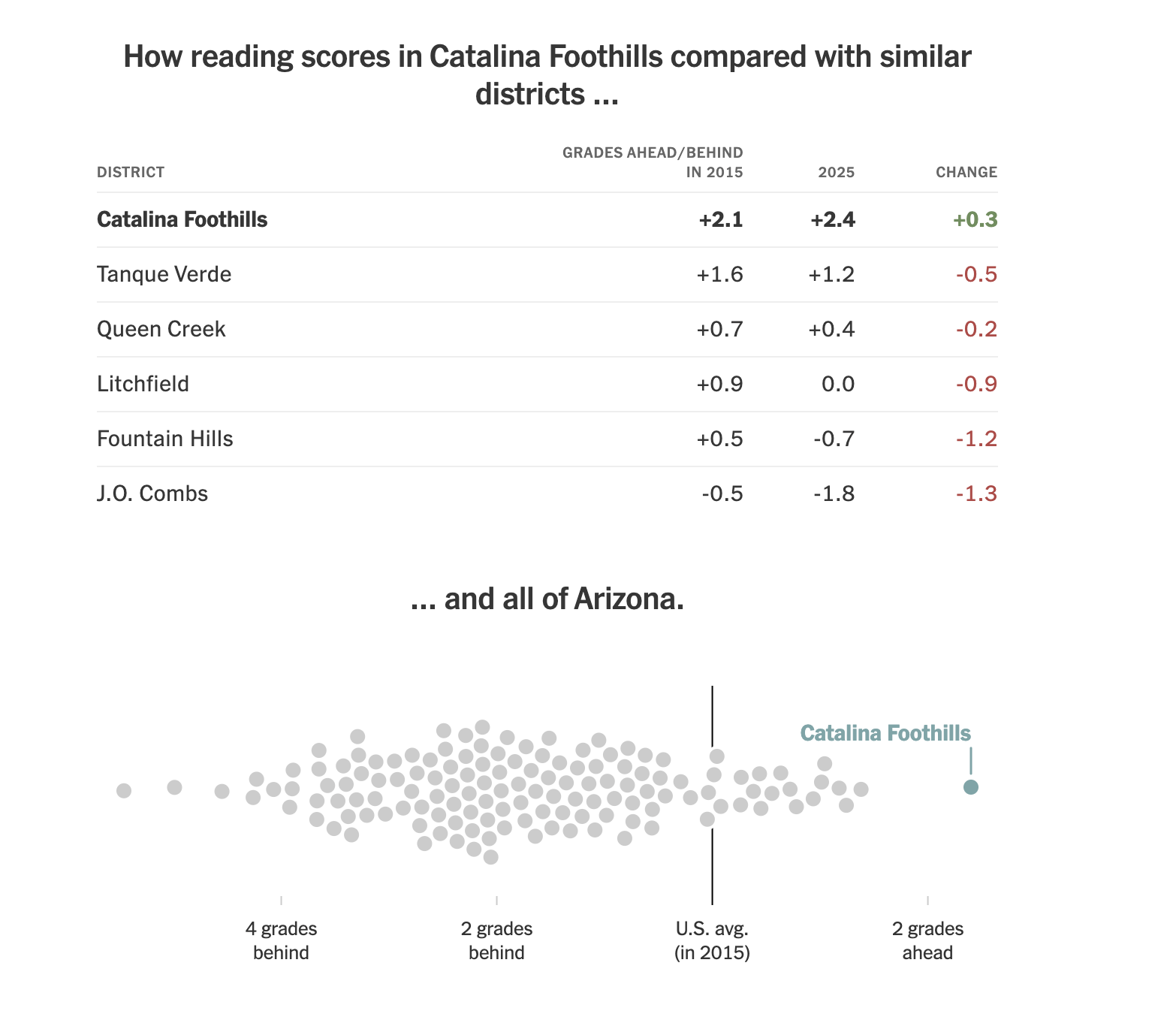 Each gray dot represents an Arizona school district. CFSD is the teal dot. Source: The New York Times / Stanford Educational Opportunity Project.
In math, CFSD students remain 1.8 grade levels above the national average. While our lead in math narrowed slightly over the decade (from 2.1 grade levels ahead to 1.8), the picture across Arizona is far more dramatic: the state average fell 0.7 grade levels in reading and 0.8 in math.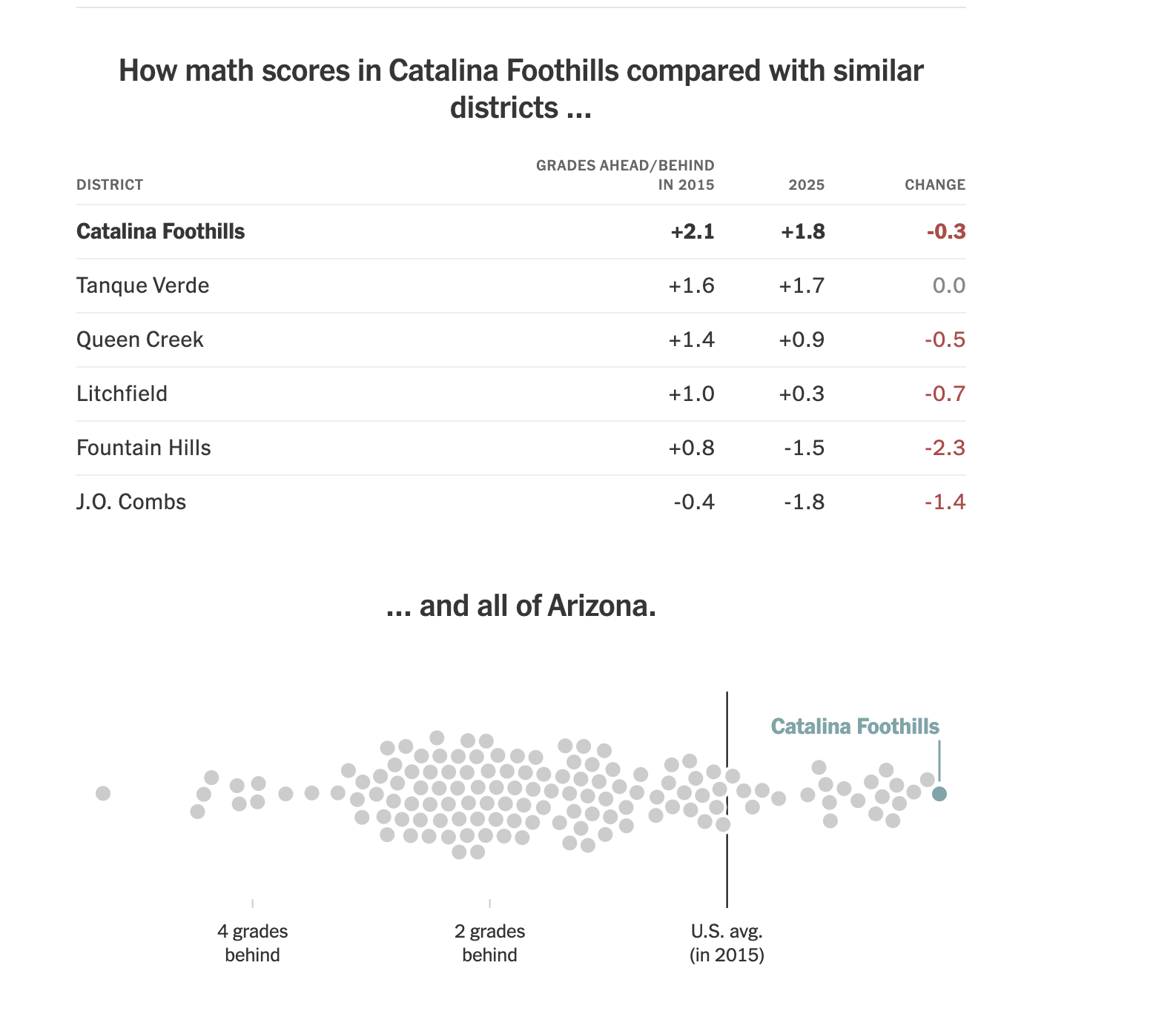 Each gray dot represents an Arizona school district. CFSD is the teal dot. Source: The New York Times / Stanford Educational Opportunity Project.
These results are encouraging, and we know we can continue to improve. We are proud of what our teachers and students have accomplished, but our work is far from over. CFSD is committed to continuous improvement, and each of our schools is focused on a clear, ambitious goal: by 2030, we aim to have 80 percent of CFSD students scoring proficient or higher on state achievement tests in math, English language arts, and science. The slight narrowing of our math achievement reminds us why our improvement work matters. We will keep investing in instruction, curriculum, and teacher development that moves every CFSD student to higher achievement.
What we want you to take from this report is that the work happening in CFSD classrooms is rare. While most of the country has lost ground, our teachers and students have largely held it. That outcome is the product of consistent effort by educators who show up every day for your children. We are grateful to them, and to you, for being part of a community that takes this work seriously and partners with us to provide a world-class education for every child.
With gratitude,
Denise D. Bartlett, Ed.D.