
Cardboard, String, and Physics: The Rube Goldberg Challenge Lab
Posted Date: 03/17/26 (05:00 PM)
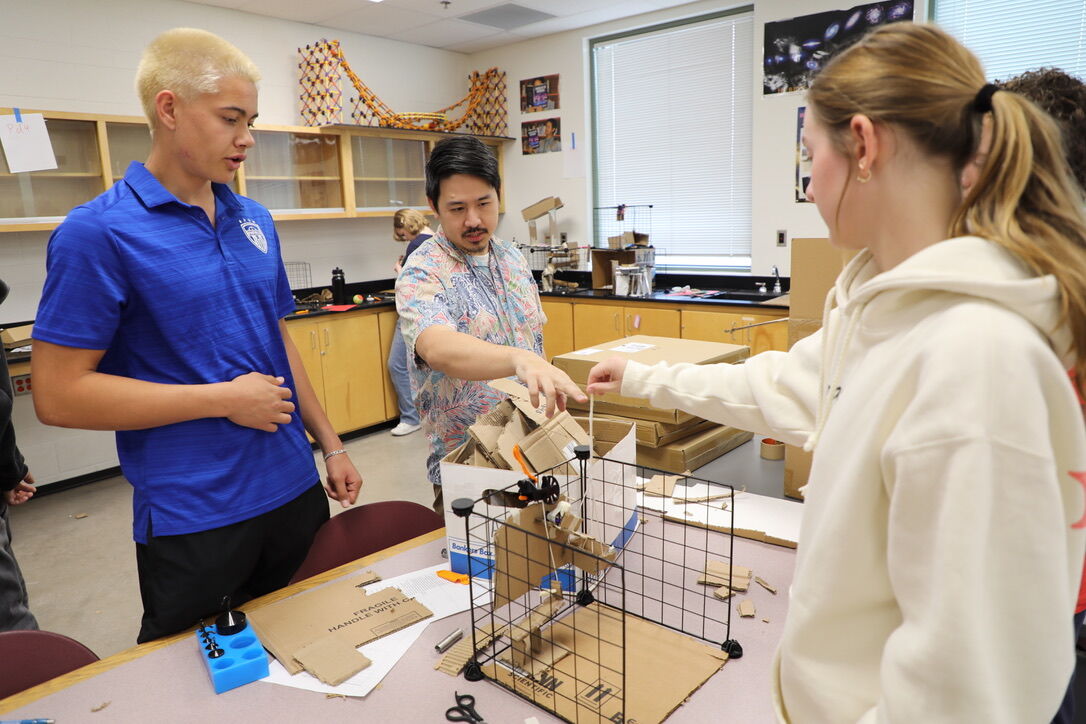 In Kevin Duong's Honors Physics class, students aren't just learning about energy conversion — they're engineering it
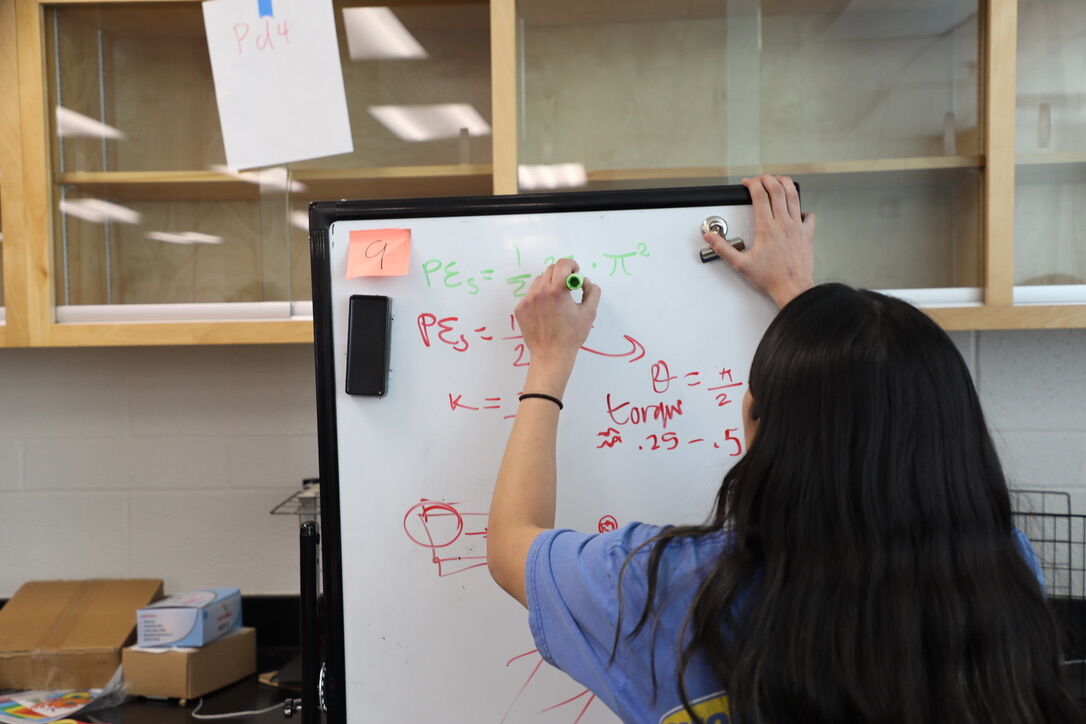
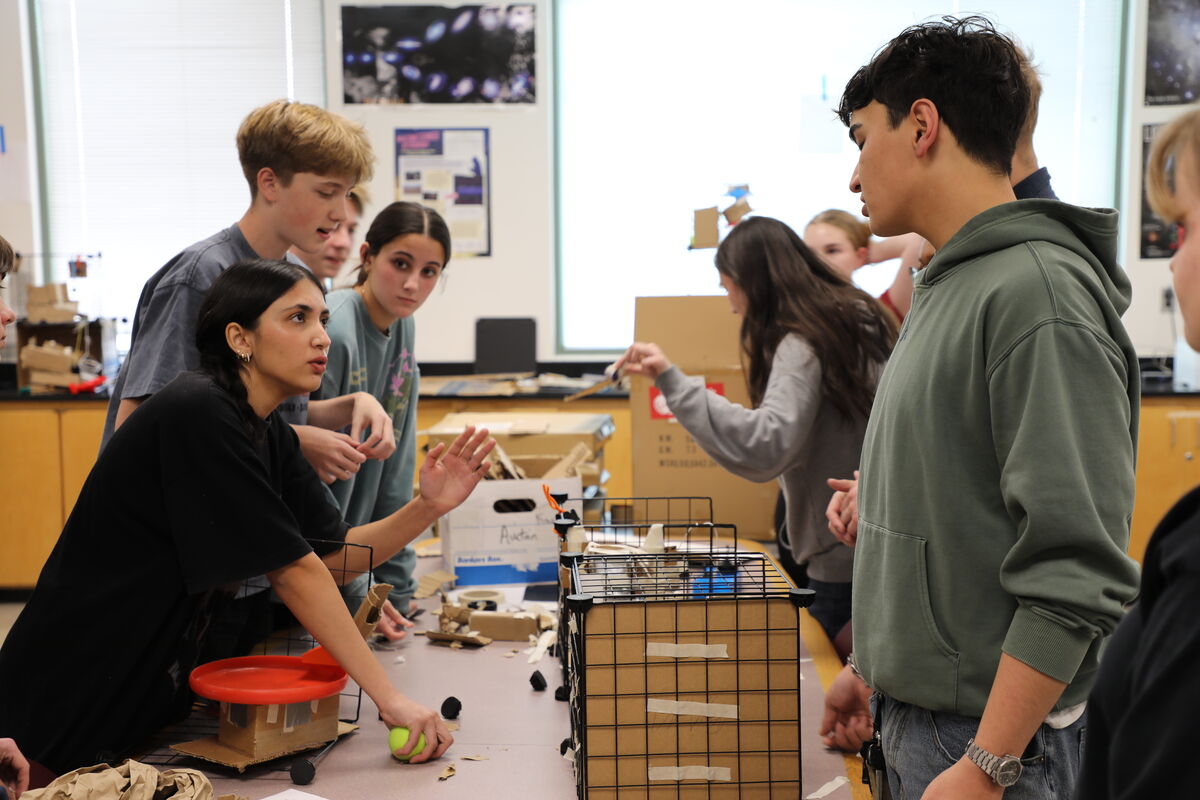
Walk into Kevin Duong's Honors Physics classroom on any recent afternoon and you might think you've stumbled into an inventor's workshop. Lab tables are buried under heaps of cardboard scraps, wire grid cubes, masking tape, and string. Students cluster around contraptions that look like miniature cityscapes: ramps leading to pulleys leading to levers leading to dominoes and a frisbee. Whiteboards are covered in equations for potential energy, torque, and spring constants.This is the Rube Goldberg Challenge Lab, and it is controlled chaos at its finest.
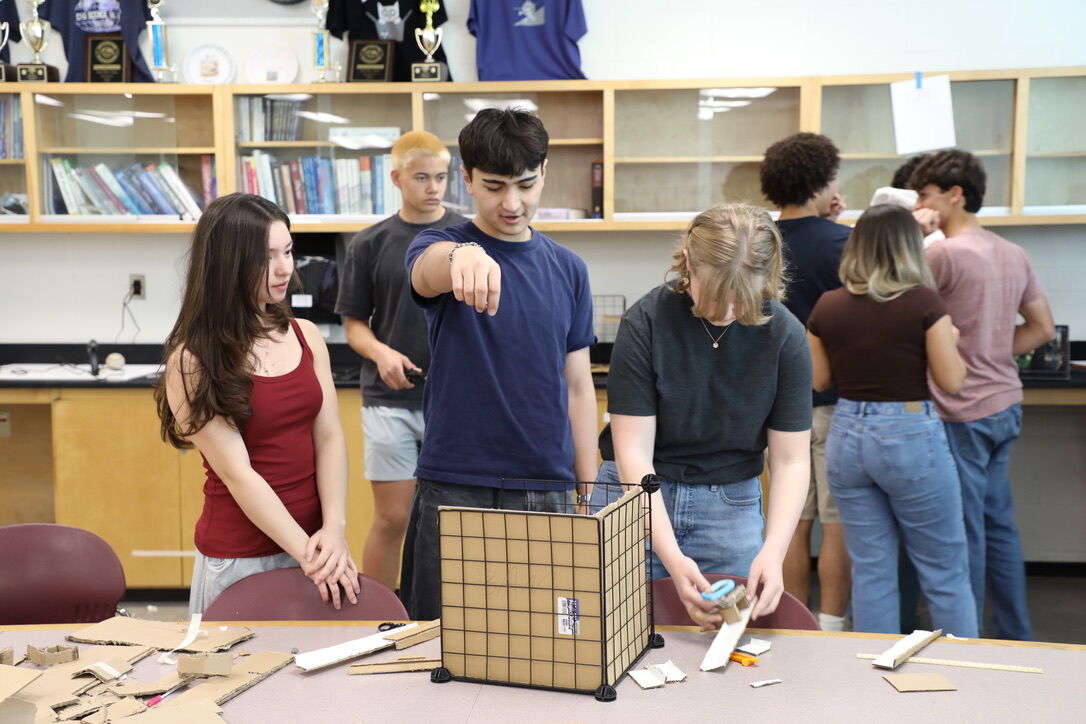
 The assignment is deceptively straightforward: working in small lab groups, Mr. Duong's Honors Physics students must each design and build one "cell" of a larger Rube Goldberg machine, which is that famously elaborate contraption that uses a comically complex chain of events to accomplish a simple task. Each cell must fit inside an approximately 12-by-12-by-12-inch wire storage cube, and when all the cells are connected end to end, the entire class's machine must do two things: start with nothing more than a standard tennis ball, and finish by lifting a 100-gram mass at least 24 inches into the air. No human hands allowed in between. Simple enough, right?
Not even close — and that's the point.
 The project challenges students to investigate how energy changes within a system and to creatively apply an engineering mindset — not just on paper, but with their hands. Each group must not only build a functioning device but also submit a technical design that calculates the energy converted in their cell and identifies exactly which energy transformations are taking place — kinetic to gravitational potential, spring to kinetic, electrical to mechanical, and so on.
 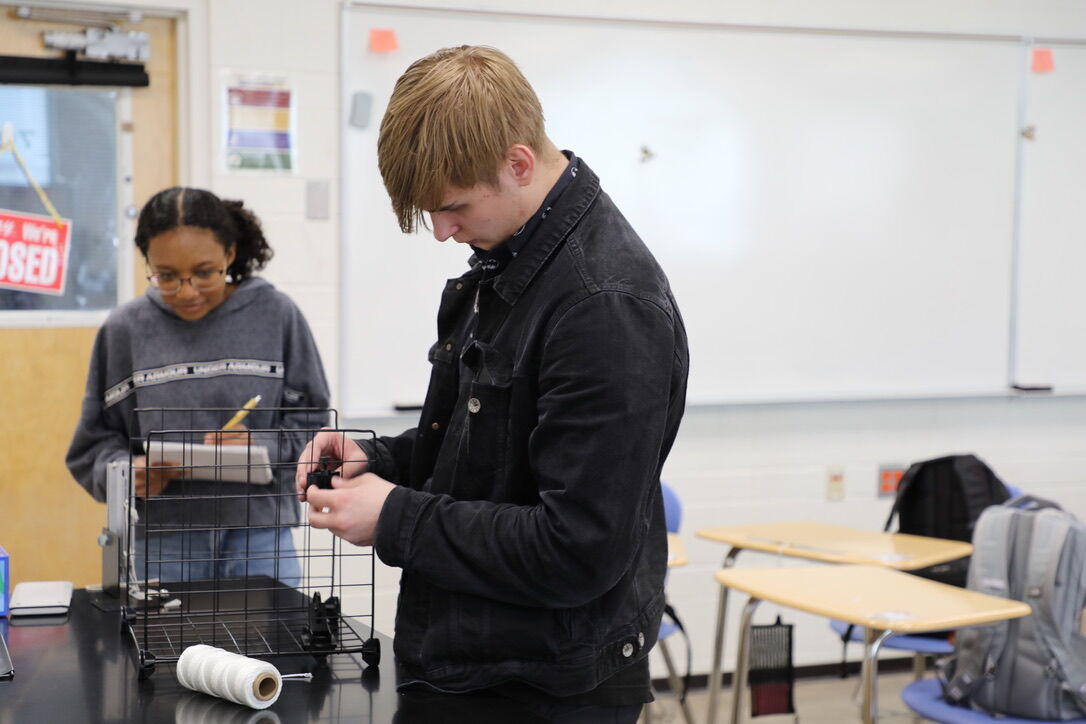 At the start of one class, Mr. Duong gathered everyone for opening announcements before releasing them to work. He reminded them to be careful with the cardboard saws and scissors, to keep the hot glue guns upright on their trays when not in use, and to check out their cell materials with him at the back table, where he was keeping careful inventory. Then came the line that captured the spirit of the whole endeavor: "If you are done or you have extra time or manpower, feel free to help each other out. This is, yes, your group project, but also your class project."
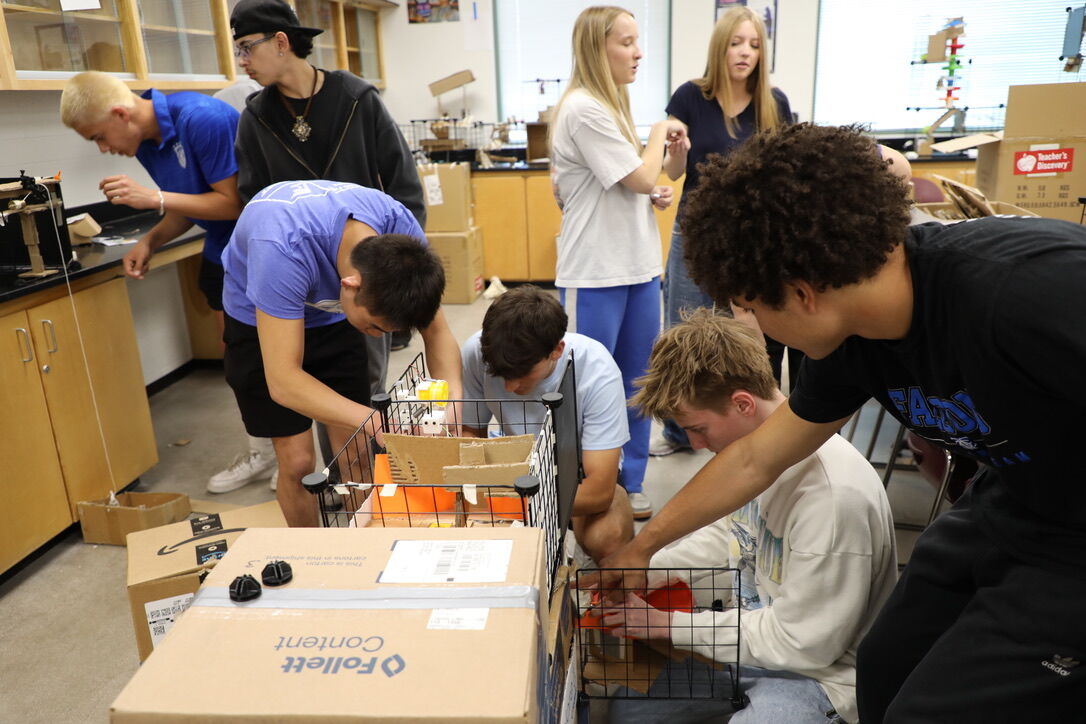 That distinction—group project versus class project—is what makes the Rube Goldberg Challenge different from a typical lab. Each small team is responsible for engineering one functioning cell, but every cell must connect seamlessly to the next. If one group's ramp doesn't deliver the ball at the right speed or angle to trigger the next group's mechanism, the whole machine fails. Individual brilliance isn't enough. The whole class has to get it right together.
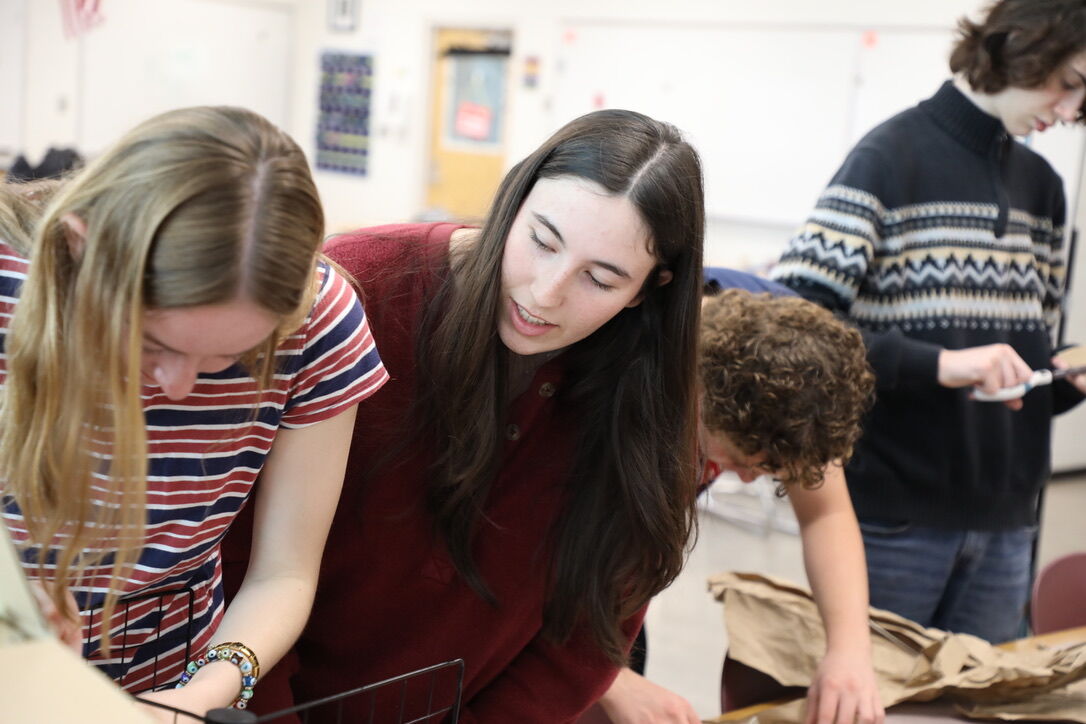 The result is a project that forces students to live inside the physics rather than just study it. A student who might breeze through a textbook problem about potential energy suddenly finds herself crouching at eye level with a cardboard ramp, trying to figure out why a tennis ball keeps veering left instead of triggering the next step. A teammate is at the whiteboard working out spring potential energy equations while another threads a string through a pulley system. And Mr. Duong is right there with them, circulating constantly. At one group's station, a student asked how to calculate the energy conversion for a spring-loaded launcher. Rather than giving the answer, Mr. Duong walked the student through the reasoning: figuring out the spring constant and compression distance would be difficult, he noted, but there was another path: calculate the gravitational potential energy at the ball's maximum height after launch, and work backward. "If you're clever about it, you find different ways to find the energy that's being converted," he told the student. "I encourage you to do that."
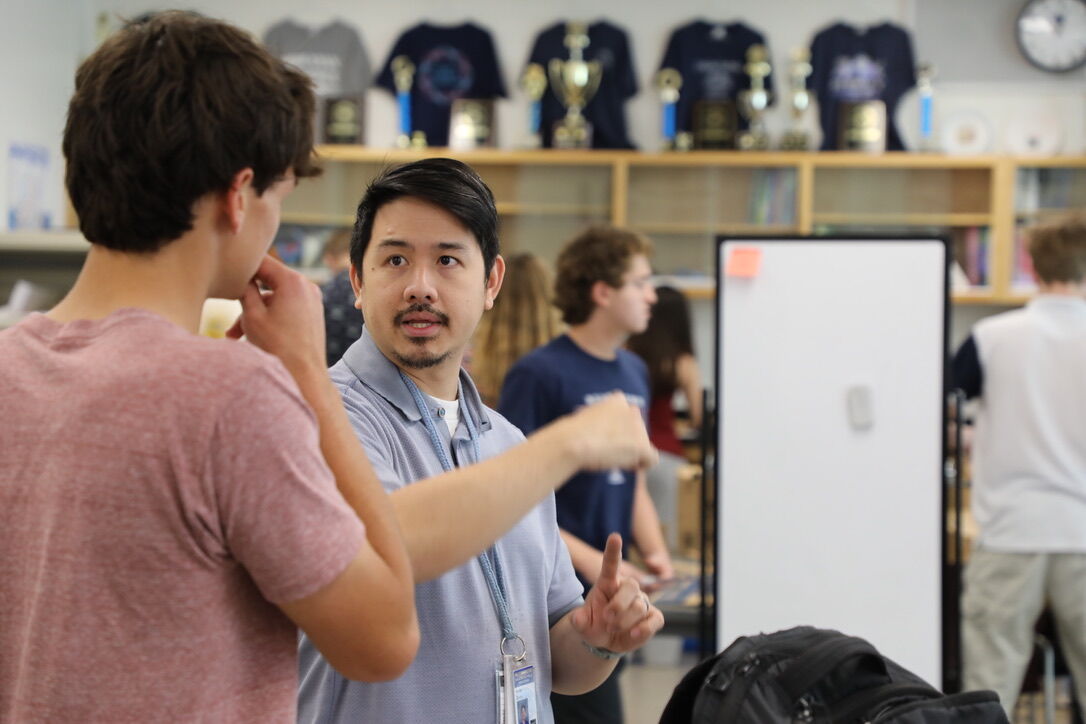 At another table, he offered a precision cut on a tricky piece of cardboard. At another, he simply watched a group test their mechanism, nodding. "I'm gonna let you cook," he said with a grin. "Nobody can tell you you're doing it wrong if no one knows what you're doing."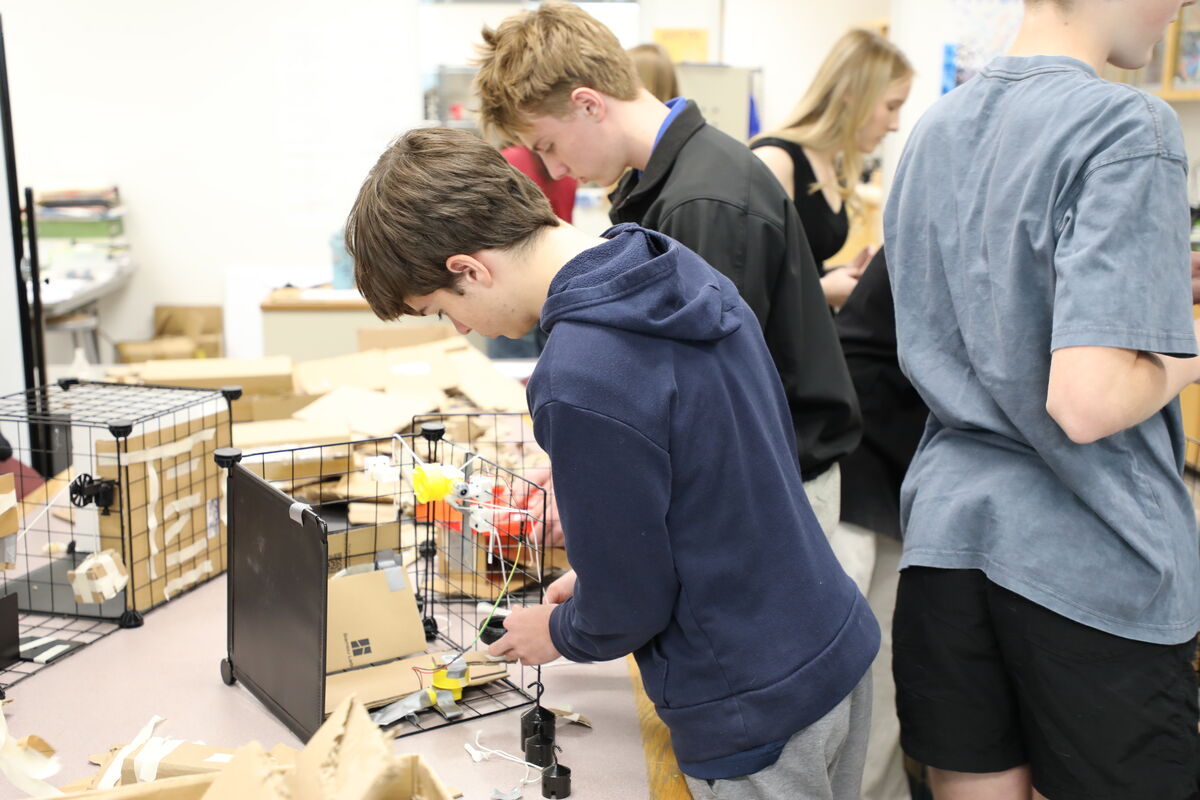
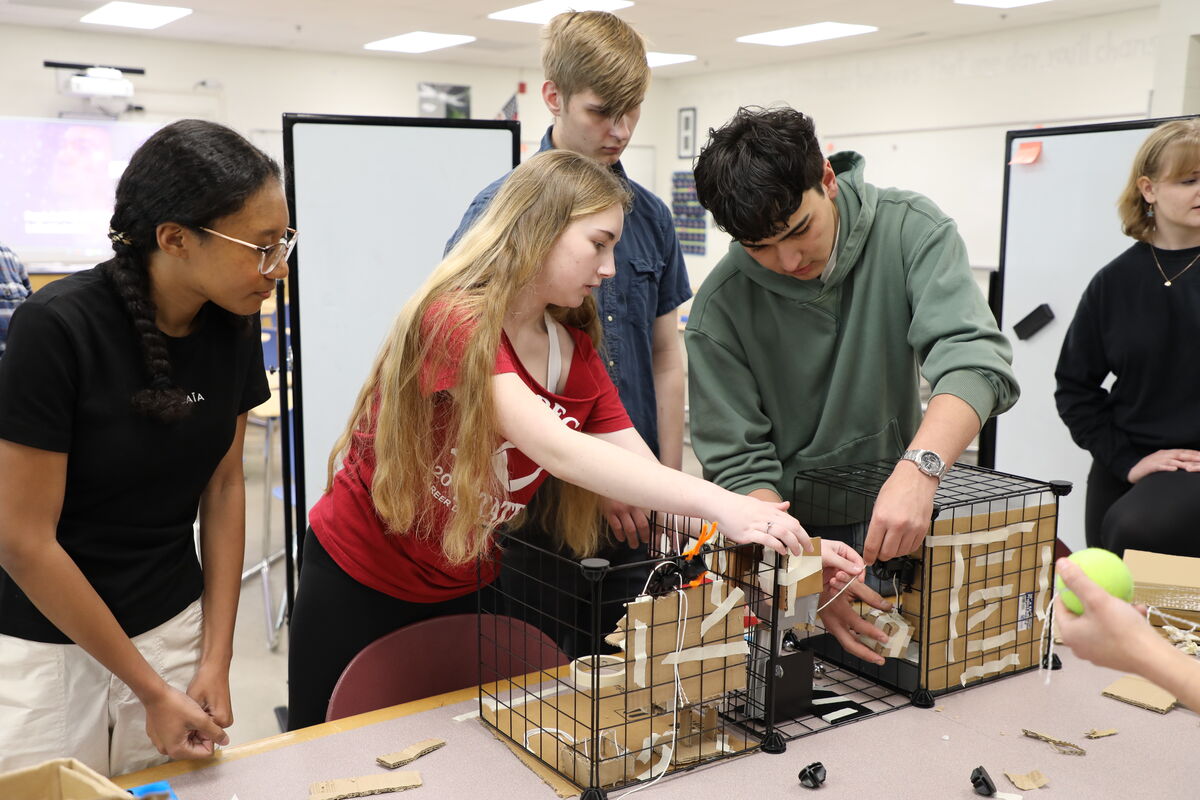
In the first days of the challenge, students are gathered around tables strewn with flattened Amazon boxes and brown paper, sketching ideas and sizing up their wire cubes. Then the building begins in earnest — hands taping ramps at precise angles, fingers threading string through tiny pulleys, careful placement of weighted masses on hooks. A closer look reveals the ingenuity at work: a tennis ball perched in a cardboard cradle at the top of an angled chute, a cylindrical mass dangling from a pulley system, pipe cleaners and rubber bands pressed into service as triggers and connectors.
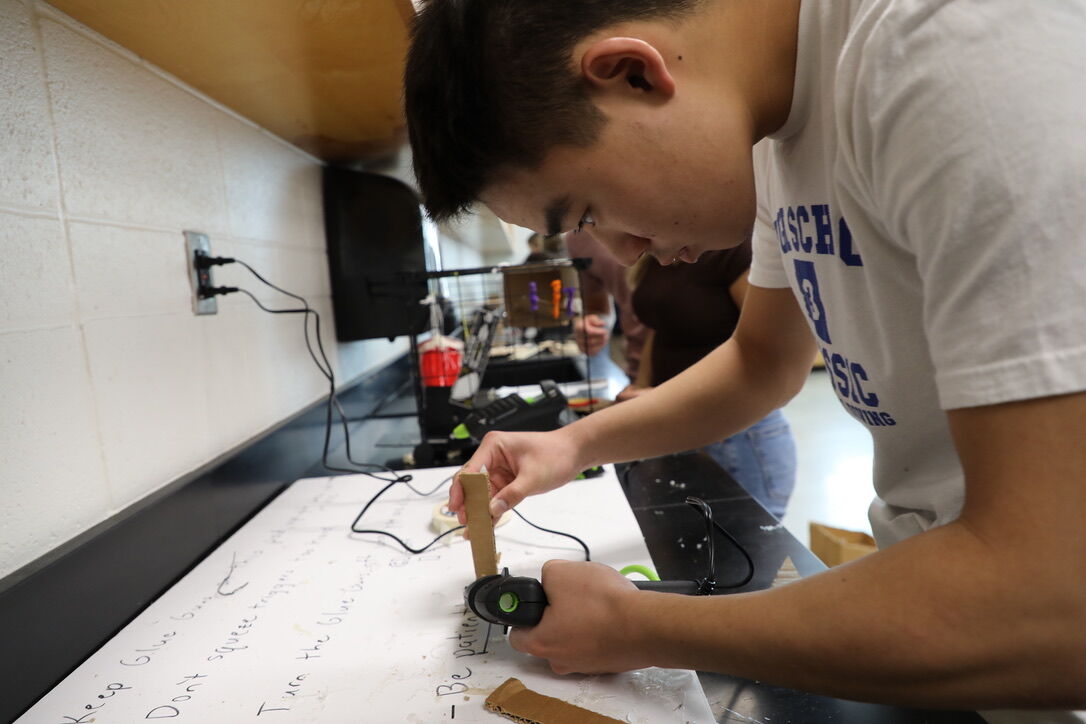
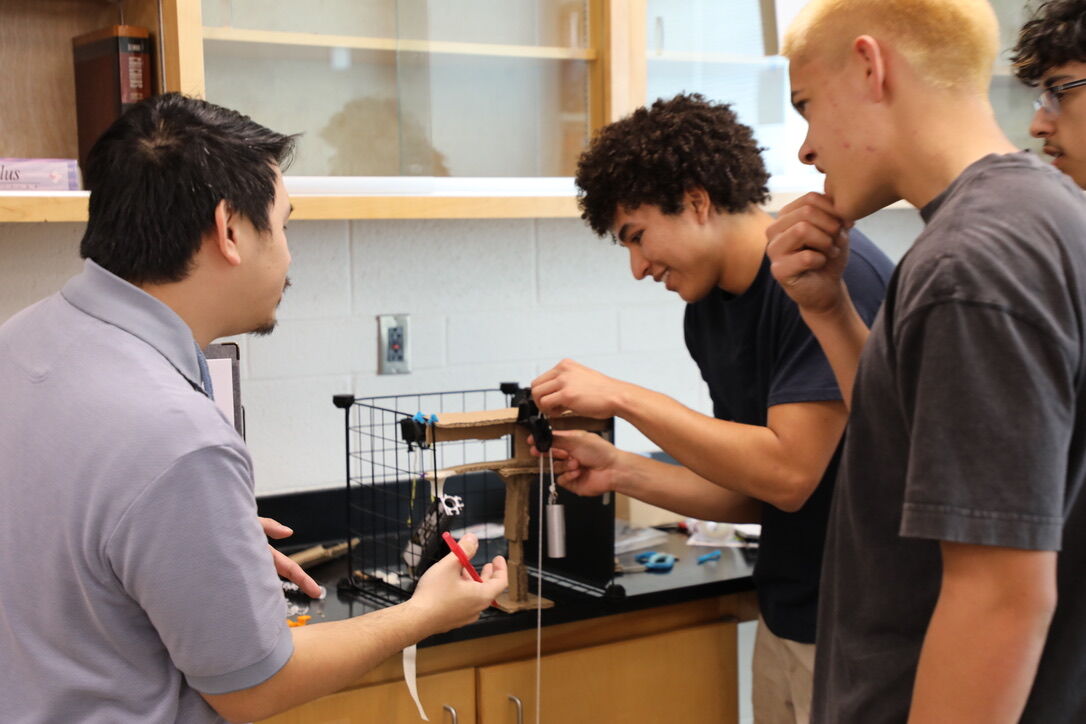 What's remarkable is the collaboration. Students lean in together, physically hunched over a shared problem. Three students study the inside of a wire cube with the intensity of surgeons. A group debates their approach while one student gestures with both hands, framing an invisible structure in the air. At the back counter, a student uses a hot glue gun with precision.
  The grading rubric reflects the project's layered ambition. A baseline score requires a working design and an energy conversion calculation. But to reach the top of the scale, the entire class's machine must function as one seamless unit — all cells working without breakdown, no human intervention, the mass lifted to full height — and hit bonus targets like incorporating energy forms beyond basic kinetic and gravitational potential, running for at least 30 seconds, or having multiple cells operating simultaneously.
 It's the kind of assignment that sticks with students long after the grade is posted, not because of the physics formulas, but because of the time they spent crouching beside a lab bench, holding their breath as a tennis ball rolled down a cardboard ramp toward a string that was supposed to pull a lever that was supposed to release a weight that was supposed to rise two feet into the air. And when it works — or doesn't — that's when the real learning happens.
 On the final day of the project, Mr. Duong's students worked right up until the lunch bell rang, making last-minute adjustments, testing connections between cubes, and fine-tuning angles with the kind of urgency that only a real deadline produces.
Then the moment arrived.
The room went quiet.
The tennis ball dropped.
The machine didn't quite make it all the way through.
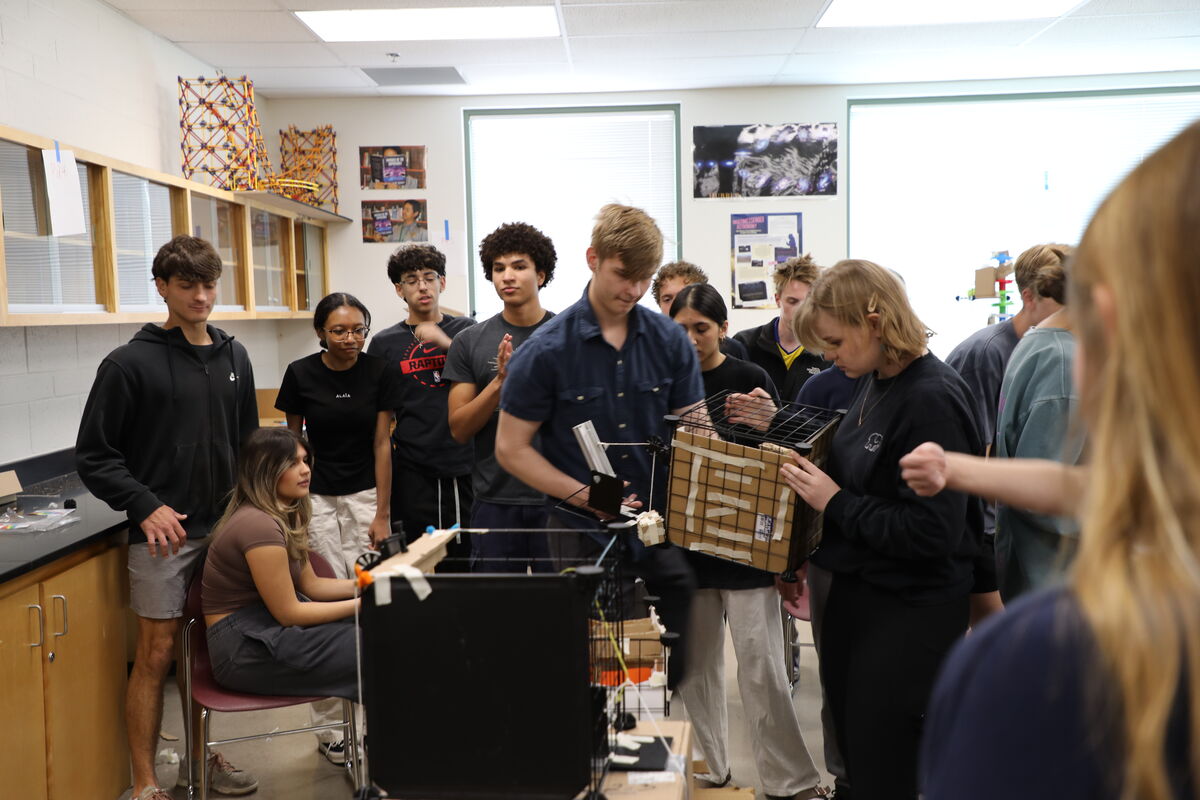 But if anyone was devastated, it didn't show. Mr. Duong called it "a valiant effort" — and in a class built around the engineering mindset, that phrase carries real weight. In engineering, as in physics, failure isn't the opposite of learning. It is the learning. Every cell that worked revealed mastered concepts. Every cell that didn't work revealed the next question worth asking.
The 100-gram mass may not have risen 24 inches into the air that afternoon. But it's a safe bet that the understanding in that room skyrocketed.
View a video of a Rube Goldberg Machine in action. This was taken by a student in a different period (6th) of Mr. Duong's Honors Physics class.